_edited.jpg)
How to Tell Clutch Is Failing Early
You notice it at a stoplight first. The pedal feels different, the truck does not move off like it used to, or the engine revs climb without the pull you expect. If you are wondering how to tell clutch is failing, the biggest clue is usually a change in how the vehicle feels under load, especially when taking off, shifting, or climbing.
A failing clutch rarely gets better on its own. In many cases, it starts as an occasional symptom that is easy to brush off, then turns into slipping, poor engagement, or a vehicle that is hard to drive in traffic. For working drivers, commuters, and truck owners across North East Texas, that can turn into lost time fast.
How to Tell Clutch Is Failing Before It Leaves You Stranded
Most clutch problems show up in the way the power gets transferred from the engine to the transmission. You may still be able to drive for a while, but the vehicle will start giving you warnings. Those warnings do not always mean the exact same failure, which is why a professional inspection matters.
One of the most common signs is clutch slipping. You press the accelerator, the engine RPM rises, but the vehicle does not accelerate the way it should. This often shows up when merging, towing, hauling, or going uphill. Drivers sometimes describe it as the engine sounding strong while the vehicle feels weak.
Another common issue is hard shifting. If the transmission resists going into gear, grinds when shifting, or feels like it wants to fight you at a stop, the clutch may not be disengaging fully. That can point to wear in the clutch assembly, trouble with the hydraulic system, or related driveline issues that need a closer look.
Pedal feel also matters. A clutch pedal that suddenly feels soft, unusually stiff, slow to return, or inconsistent from one drive to the next is worth taking seriously. A lot of drivers ignore pedal changes because the vehicle is still moving, but that small difference can be the first sign that a bigger problem is building.
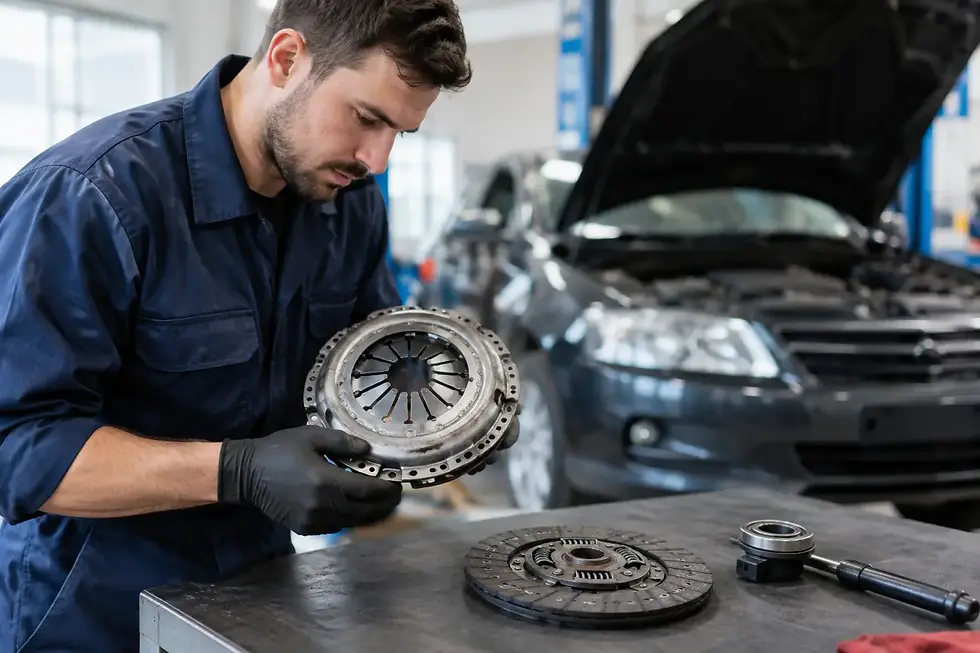
Then there is noise. A bad release bearing, pressure plate issue, or related component can cause chirping, rattling, grinding, or squealing, especially when the pedal is pressed or released. Noise alone does not confirm the exact failure, but it is one more sign that the clutch system needs attention.
The Most Common Symptoms Drivers Notice
In real-world driving, clutch problems are not always dramatic at first. They tend to show up in patterns. The vehicle may shudder when taking off from a stop. Reverse may become harder to engage. First gear may feel rough in traffic, even if higher gears seem mostly normal for now.
A burning smell is another warning sign drivers should not ignore. When a clutch is slipping, excess heat builds up. That heat can create a sharp burnt odor, especially after stop-and-go driving, backing a trailer, or pulling under load. Sometimes the smell fades, but the wear does not.
You might also notice the engagement point changing. If the clutch starts grabbing much higher or lower than normal, that change matters. Vehicles develop a familiar feel over time, and when that feel changes noticeably, it usually means something in the system is wearing or no longer operating as it should.
Some customers ask whether occasional symptoms are really a problem if the vehicle still drives. The honest answer is that it depends on what is failing, how far the wear has progressed, and how the vehicle is being used. A lightly driven car may limp along longer than a work truck, but once slipping starts, added wear can happen quickly.
Why Clutch Problems Can Feel Like Something Else
This is where experience matters. Not every symptom that feels like a clutch issue is only a clutch issue. Problems in the hydraulic system, flywheel, transmission input area, transfer case, or other driveline components can create similar complaints.
That is why broad advice online can be misleading. One driver may describe a slipping sensation, while another complains about hard shifting, and both assume they have the same problem. In the shop, those vehicles can end up needing very different repairs.
For that reason, the right move is not guessing. It is getting the vehicle checked by a shop that works in transmissions, clutches, and geartrain systems every day. That matters even more for commercial vehicles, diesel trucks, and heavy-duty applications where driveline stress is higher and downtime costs more.
When to Bring It In
If the vehicle slips under acceleration, struggles to go into gear, makes noise when the clutch pedal is used, or gives off a burnt smell, it is time to schedule service. Waiting can lead to more wear on related parts, more difficult driving, and in some cases a vehicle that cannot be driven safely or reliably.
The timing matters. Catching clutch trouble earlier may help limit collateral damage and reduce how long the vehicle is down. Waiting until the clutch fully gives out usually means fewer options and a more inconvenient repair timeline.
For customers in Mabank and across the tri-state area of Texas, Oklahoma, and Louisiana, Barton's Transmission & Supply LLC is built for this kind of work. With 50 years in business, a 17,000 square foot facility, 14 lifts, a large staff, and specialized driveline and transmission expertise, the focus is simple: identify the real problem, repair it correctly, and get you back on the road fast.
What Professional Clutch Service Should Include
A proper clutch complaint should be evaluated as part of the full driveline picture, not treated like a generic repair. That means looking at the clutch components, related hydraulics, flywheel condition, shifting complaints, and any signs that the transmission or geartrain may also be involved.
That is especially important on vehicles used for work. If you drive a truck for your business, pull trailers, commute long distances, or rely on your vehicle every day, you need more than a quick opinion. You need a shop that understands the load demands on the system and repairs for long-term durability, not just a temporary fix.
Barton's Transmission & Supply handles clutch replacement, standard transmission rebuilds, differential work, transfer case repair, heavy-duty and commercial rebuilds, and geartrain diagnosis. That narrow specialization is a big advantage when symptoms overlap. Instead of bouncing between general repair guesses, customers can bring the vehicle to a team that works on these systems full time.
The company also works with all extended warranty companies and is a preferred vendor for many of them, which can make the process easier for customers already dealing with a major repair concern. Warranty coverage matters, and so does confidence in the work after the vehicle leaves the shop. Barton's backs repairs with a long standard warranty of 3 years or 30,000 miles, with options up to 3 years or 100,000 miles.
How to Tell Clutch Is Failing in Work Trucks and Daily Drivers
The warning signs can show up a little differently depending on the vehicle and how it is used. In a daily driver, the first complaint may be a clutch pedal that feels off in traffic or a gear that does not want to engage cleanly. In a work truck, the first red flag may be slipping under load, poor takeoff performance, or a smell after towing.
That difference matters because usage changes how quickly a problem gets worse. A vehicle that spends its life in town may show symptoms gradually. A truck that hauls, tows, or works in heavier service can push a worn clutch to failure much faster.
Either way, the message is the same. If the vehicle feels different, smells hot, shifts poorly, or stops transferring power the way it should, do not ignore it and hope it clears up. Clutch problems tend to cost less in stress and downtime when they are addressed before they become a breakdown.
If you are near Mabank or anywhere in the North East Texas market, Barton's Transmission & Supply LLC at 1900 S. 3rd Street, across from Tractor Supply, is equipped to help with clutch concerns and related driveline problems. The shop offers quick turnaround, financing support, bilingual customer service, expert rebuild capability, and dependable repair backed by strong warranty coverage. If your vehicle is starting to tell you something, this is the time to listen.


Comments